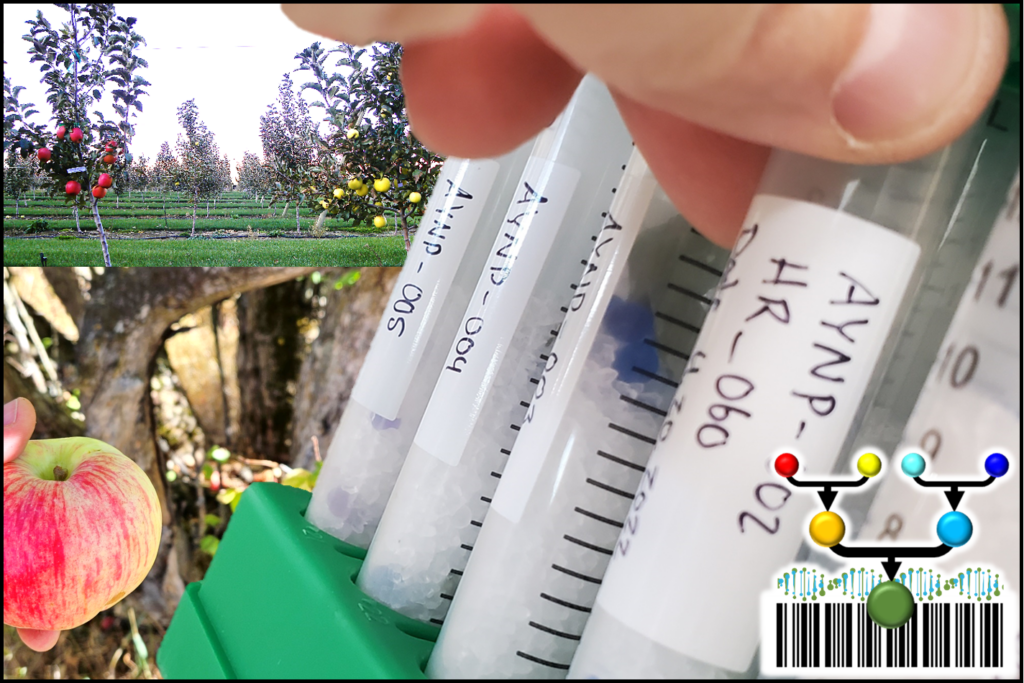
Helping you name and value your U.S.-grown apple trees!
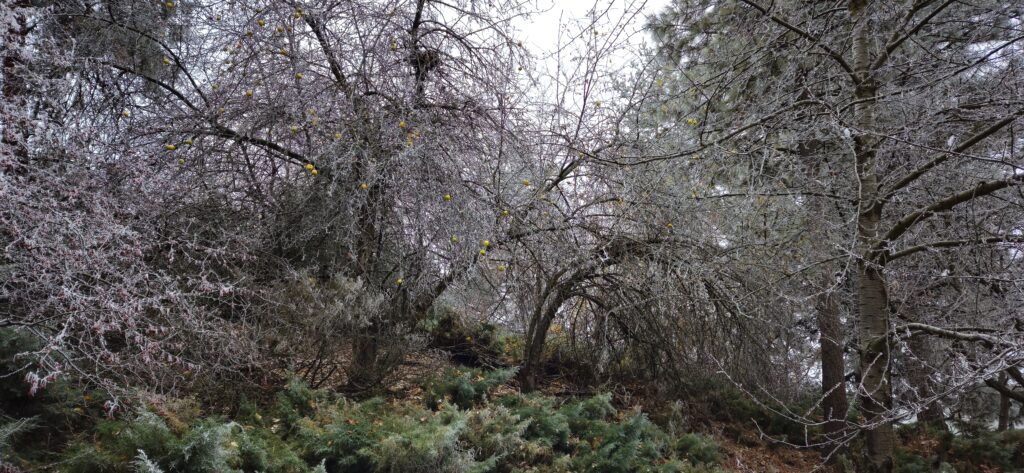
What’s that tree?
Have or know of an old apple tree that you would like to identify? Misnamed or missing-named family heirloom? The MyFruitTree project exists to help you and all of us gain an understanding of and appreciation for the diversity and history of apple trees in our landscape and lives.

Who we are
We are a non-profit, public research lab located in Washington State University’s Department of Horticulture. We are a small team of tree fruit geneticists with decades of experience detecting and dissecting differences among apple cultivars in the U.S. and around the world. Our team includes grad and undergrad students. We collaborate widely with institutions, groups, and individuals across the U.S. (and world) – see Our Partners page.
Our mission is to democratize access to the inherent value of any apple tree. We are doing this by determining the identity or uniqueness of apple trees across the U.S., rediscovering lost heirlooms, revealing the hidden pedigree network among apple cultivars and trees, dissecting the genetic control of traits of interest, and supporting breeding.
DNA fingerprinting
DNA fingerprinting (aka DNA testing, genotyping, genetic analysis) using your leaf samples is available by request on a submitter-pays basis.
Recommended first step: We offer a “Simple test” that will cost you $50 per sample (and takes 3-4 months). For each tree DNA-tested, this method uses a small amount of leaf tissue to definitively determine identity (whether the tested tree is identical to a named cultivar already in our Reference Panel) and is best suited for any tree suspected to be a cultivar and not a one-off seedling tree. Such one-offs will have a unique DNA profile and therefore cannot be identified as an existing cultivar. The Simple test can also often identify one or both probable parents, or else general pedigree position, but it’s optimized for identity-checking.
Contact us to get your tree(s) Simple-tested
Unidentified trees: In some cases, rare, newly imported, or newly developed cultivars will not immediately be identified as named cultivars (if they are not in our Reference Panel), but their DNA profiles join our extended dataset and hopefully will be identified in the future as evidence accumulates. Our extended dataset includes Accessory Profiles, which are DNA profiles of genetically distinct individuals for which historical cultivar names are attached but the evidence is not yet sufficient for us to be confident enough in the identity. Our extended dataset also includes some mystery cultivars: DNA profiles obtained from one or more trees with strong evidence of being a cultivar but no historical cultivar name yet attached. Solving such cultivar name mysteries and confirming names for Accessory Profile entries is an objective of the interdisciplinary Historic Fruit Tree Working Group of North America.
Deeper investigation: We also offer a “Full test” that will cost you $150 per sample (and can take 6-9 months), but usually we recommend using this option only if your Simple test results for the tree indicated uniqueness and inconclusive parentage. While both test levels are definitive for cultivar identity, only the Full test is definitive for parentage, if the parents are in our dataset, and otherwise gives clearer information on pedigree position.
Technical details: The “Simple test” uses 48 hand-picked SNP (single nucleotide polymorphism) markers via the KASP (kompetitive allele-specific PCR) genotyping platform. The “Full test” uses several thousand hand-picked SNP markers via the Flex-Seq genotyping platform. LGC Genomics is our commercial service provider for running the DNA extraction and genotyping using the collated leaf samples and SNP marker information we provide. We analyze the raw data by converting SNP genotype scores into our format and then comparing each DNA profile to our Reference Panel and extended dataset.
We cannot distinguish among sports: Sports of cultivars cannot be distinguished by our DNA fingerprinting methods, as the tiny differences in the DNA of any sport from its base cultivar are too specific. So, for example, Gravenstein, Red Gravenstein, and any other Gravenstein sport will have the same DNA profile from our testing and the result of testing any of these will just be Identified: Gravenstein. Similarly, Ben Davis, Black Ben Davis, and Gano effectively have the same DNA profile and so the DNA test result will just be Identified: Ben Davis.